
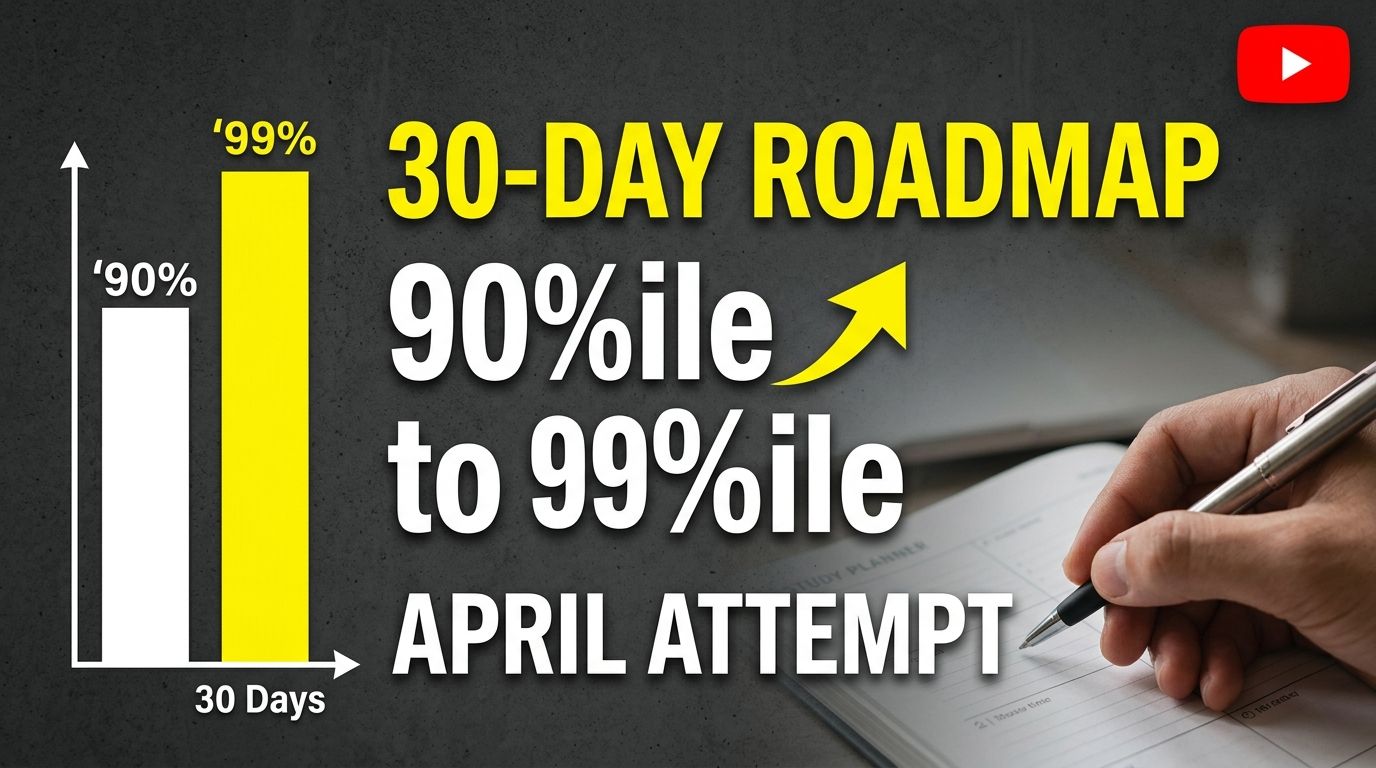
The January 2026 JEE Main session results established a clear, albeit challenging, scoring baseline for engineering aspirants. This milestone provides a critical diagnostic for planning the April attempt.
Securing a top NIT seat often requires a strategic jump in the final session. Many students follow established chapter-wise trends but struggle with execution during the actual exam window. Improving accuracy and speed is the defining factor in shifting from a 90 to 99 percentile category.
The Reality of the April Attempt in 2026
Honestly, the April session is a completely different environment. NTA wrapped up the January 2026 exams on January 29th, and those results came out on February 16th. During the April 2-9 window, the competition naturally gets thicker because everyone has had time to recover from board exams. For a deeper dive, check out our analysis on Jan vs April Difficulty.
- The baseline shifts: A score that comfortably got you 90 percentile in Jan might only grab an 88 in April. Everyone is just a bit more polished.
- Shift difficulty is random: In Jan 2026, a really tough shift meant you needed maybe 150 marks for a 99 percentile, but an easy shift pushed that target closer to 200.
- The massive score gap: Jumping from 90 to 99 percentile isn't about tweaking a few habits. You are essentially trying to double your score from roughly 90 marks to 180+ marks.
Data Breakdown: Jan 2026 Statistics
| Target Percentile | Estimated Marks (Jan 2026) | The Reality Check |
|---|---|---|
| 90.0 %ile | 80 - 100 marks | You know the syllabus, but lack speed. |
| 95.0 %ile | 120 - 140 marks | Good grasp of basics. Less negative marking. |
| 99.0 %ile | 180 - 210 marks | Near-perfect execution. You know what to skip. |
Our Take: Looking at these 2026 numbers in our Marks vs Percentile Guide, something stands out. The gap between 90 and 95 percentile is only about 40 marks. That is literally just 10 extra correct questions. Master about 80% of the syllabus so deeply that your pen doesn't stop moving.
Day-by-Day 30-Day Action Plan
To move your score from a 90 percentile base to the 99 percentile bracket, you need a rigid calendar. You cannot afford to study randomly. A 30-day block must be split into three core phases: fixing gaps, building speed, and structural full-length mock simulation. Here is how you should break down your daily routine.
Days 1 to 10: Eliminating High-Yield Blind Spots
During the first ten days, your main target is to isolate chapters where you understand the formula but always mess up the numerical solution. Look back at your January test record. For most students at 90 percentile, the missing marks sit in physical chemistry calculations, coordinate geometry, and electrodynamics.
Spend 4 hours every morning solving your weak high-weightage topics. Do not read theory books for hours. Instead, open the past three years of paper archives and solve 30 questions per chapter without looking at hints. In Chemistry, prioritize high-scoring blocks like Organic mechanisms and d-and-f block elements. For Physics, make sure you can solve basic rotation and modern physics questions without hesitation.
Days 11 to 20: Speed Drills and Error Logs
By day eleven, you must stop focusing on new theory entirely. This phase is dedicated to increasing your problem-solving speed. If you take too long to solve a single Math question, you lose the opportunity to look at three easy Chemistry options.
Start doing daily time-bound chapter sprints. Set a timer for 45 minutes and try to clear 25 multiple-choice questions from a specific subject block. When the timer rings, stop writing immediately. Count how many questions you got wrong due to silly calculation errors, misreading the units, or choosing the wrong formula. Maintain a physical error notebook. Write down the exact reason for every single error. Read this notebook every night before sleeping so you do not repeat the same mistakes during your actual exam session.
Days 21 to 30: Full-Length Exam Mimicking
The last ten days require complete mental conditioning. You will write a full three-hour mock paper every alternate day. You must take these tests during the exact shifts set by NTA—either 9:00 AM to 12:00 PM or 3:00 PM to 6:00 PM. This aligns your brain biological clock to peak analytical performance during those hours.
Do not take low-quality practice papers from random internet forums. Use actual shift papers from recent sessions as your full mocks. Spend at least two hours analyzing your test data immediately after finishing. If your score stays flat, analyze if you are getting trapped in difficult questions during the first hour. Your goal in the final week is to protect your accuracy and master paper navigation. Learn to drop tough multi-concept questions within 30 seconds so you can save energy for the straightforward, direct scoring questions.
Strategic Advice for Students
So, what do you actually do today? First, close the endless "one-shot" revision videos on YouTube. If you are sitting at 90 percentile, your underlying theory probably isn't the main issue. Your problem is application under pressure.
Grab a notebook right now. Write down the specific subjects where negative marking destroyed your January score. Honestly, it's usually Chemistry. Spend the next few days just grinding through the raw January 2026 papers. Just do them. Don't look at the answer key first.
Also, rethink how you navigate the paper. I know it sounds basic, but some students start with Chemistry to bank time, then panic when Physics is harder than expected. Find a rhythm that works for your specific brain.
Frequently Asked Questions
Is 60 days actually enough time to jump from 90 to 99 percentile?
It really depends on your work ethic, but yes. You need to increase your score by about 80-90 marks. That means securing 20-25 more correct questions, which requires aggressive mock testing, not just passive reading.
How many mock tests should I take before the April 2026 attempt?
I'd suggest about two per week right now. Once you hit late March, maybe push it to three. Don't just take them, though—you have to spend two hours analyzing every single mistake you make.
Should I study new topics or just revise what I already know?
If a topic is completely foreign to you and it carries low weightage, just ignore it. Focus your energy on strengthening the high-weightage topics where you currently only have a surface-level understanding.