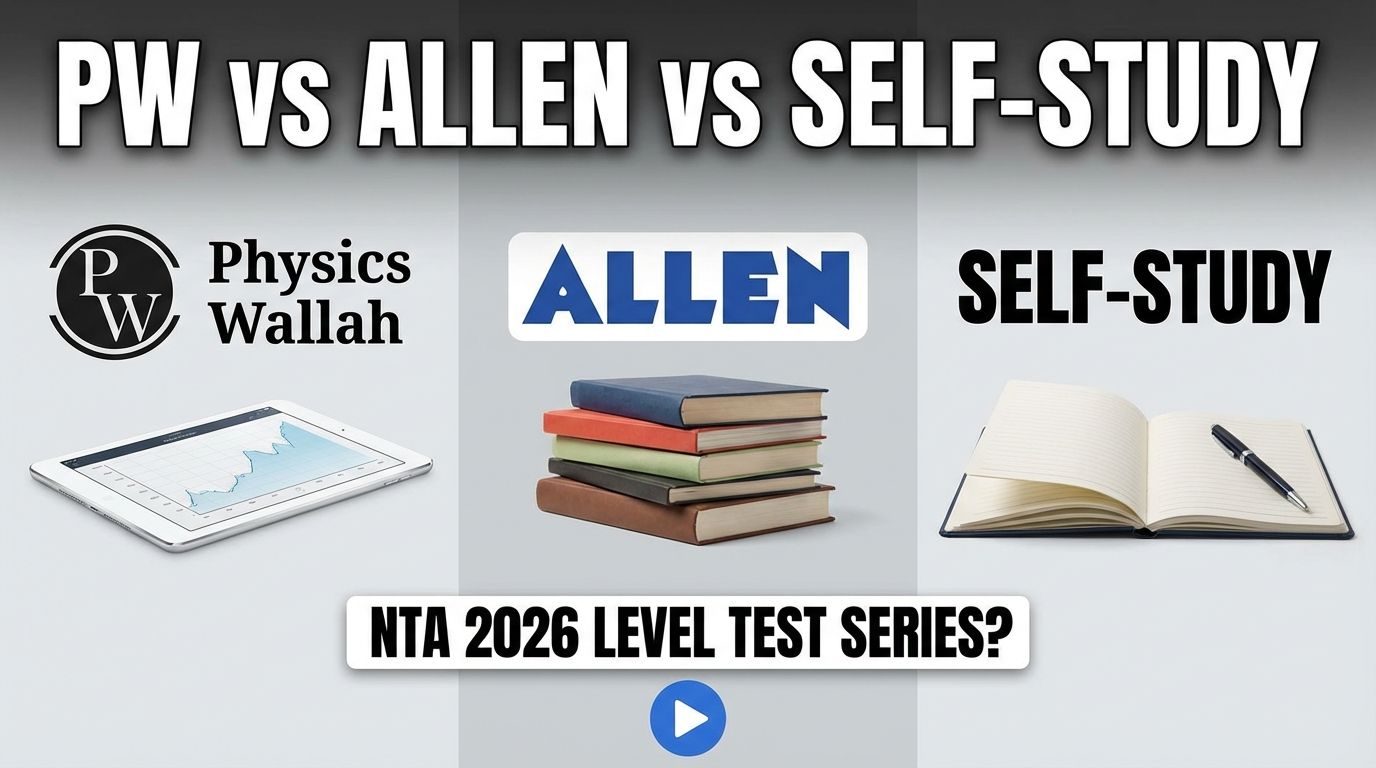
Every year around this time, students preparing for NTA exams — JEE, NEET, whatever — face the same question. And honestly, the more I look at how people answer it online, the more I think most of those answers are useless. Either it's an Allen ad disguised as a review, or it's a Physics Wallah fan being defensive, or someone who cracked JEE in 2019 telling you their routine like it still applies.
So let me just think through this properly. For NTA 2026. Right now.
First — What Has Actually Changed for NTA 2026?
NTA has been through a rough patch. 2024 was messy — paper leaks, re-tests, court cases. 2025 wasn't exactly calm either. For 2026, there are structural changes in how papers are set and how normalisation works. The exam pattern adjustments matter here because they shift what kind of preparation actually helps.
If the paper is more application-based — which is the general direction NTA seems to be moving toward — then rote-heavy approaches become weaker. That's relevant when you're comparing these three options.
Physics Wallah in 2026 — Not What It Was in 2021
PW blew up because Alakh Pandey was genuinely good at teaching physics on YouTube. Like, really good. Clear explanations, the right kind of rough edges, and completely free. That was the whole thing.
But PW in 2026 is a different animal. They've expanded into centres, hired hundreds of faculty — some great, some average — and launched multiple batch tiers. Arjuna, Lakshya, batch names change every year. The pricing has gone up. Not Allen-level, but it's not the "₹999 for everything" pitch anymore either.
What PW still does well is content accessibility. The app works. The videos are mostly good. For students in smaller towns where Allen doesn't have a centre and internet is decent, PW is still probably the strongest option by a wide margin. Actually, I'd say that's their real strength — reach. Not just price.
Where it gets complicated — the doubt-clearing experience is inconsistent. Some students swear by the Telegram groups and mentors. Others say they waited three days for a response and got a generic link. It depends heavily on which batch, which faculty, and honestly a bit of luck.
Allen — Still the Kota Benchmark, But With a Reputation to Protect
Allen isn't going to be undersold on results. Their toppers list is real. The infrastructure at Kota — the study environment, the peer pressure, the sheer density of serious students in one place — does something to your preparation that no app can replicate. That's just true.
But. And this is a big but. Allen works best for a specific kind of student. Someone who is already reasonably strong, who can handle a high-pressure environment without falling apart, and whose family can manage the cost and the distance. The fees — when you add hostel, food, study material, and the base tuition — can easily cross ₹3 to 4 lakh for a two-year course. That's not nothing.
For students who struggle with the pace, Kota can be brutal. The dropout rates at coaching centres there are not small. You don't hear about those students as much because they don't get featured in the success stories, but they exist.
Allen's online division — ALLEN Digital — has improved. But if you're going online anyway, the question of whether you're actually getting the Allen advantage becomes murkier. The live classes are fine. The test series is genuinely excellent — probably better than PW's for NTA simulation. That part I'd give them without hesitation.
Self Study — Misunderstood, Not for Everyone, Sometimes the Best Option
People treat self-study like it's a third option that only works if you're some kind of genius. That's not right. And it's also not right to say "anyone can self-study with enough discipline" — that undersells how hard it actually is without external structure.
Self-study for NTA 2026 means — NCERT, a solid reference book (DC Pandey for physics, OP Tandon or N Avasthi for chemistry depending on what you're targeting), a good question bank, and a test series. That last part is non-negotiable. You cannot self-study effectively without taking full mocks under timed conditions and then actually analysing them.
The real cost here isn't money. It's the absence of a peer group. When you're stuck on something at 10 PM and there's no one to ask, that frustration is real. Some students handle it fine — they've built a WhatsApp group with friends, they use PW's free YouTube content for hard topics, they book occasional doubt sessions. But it requires active effort to build that support structure yourself.
I know one student — this was a few years ago, NEET aspirant, smaller town in Andhra — who self-studied almost entirely, used free YouTube, bought one test series subscription, and got a rank that would've made any coaching centre claim her as their own. But she was also studying 10 hours a day with almost no social life. That's the version that works. Not the "self-study while watching Netflix" version.
The Honest Comparison Nobody Wants to Make
Here's what I actually think, after looking at this for a while:
If your problem is access to good teaching, PW solves it cheaply and adequately for most topics. If your problem is environment and accountability, Allen at Kota genuinely works — if you can afford it and survive the pressure. If your problem is money and you have enough self-discipline, self-study with a paid test series is competitive.
What doesn't work is picking one based on whose ads you saw last or which influencer you follow.
The students who do well in NTA 2026 will mostly be students who studied consistently, took a lot of mocks, and reviewed their mistakes properly. That part is the same across all three routes. The coaching institute doesn't do the studying for you. It just changes the conditions under which you study.
A Few Specific Things Worth Knowing
PW's Arjuna batch for JEE and similar tiers — the content quality is high but the batch size is massive. Don't expect personal attention unless you're paying for a premium tier.
Allen's test series is genuinely one of the best available for NTA simulation. Even if you're not enrolled with them, buying just the test series is worth considering. It's available separately.
For self-study, Aakash's test series and PW's test series are both reasonable options. FIITJEE's is harder and can be demoralising if you're early in preparation — I'd save it for later.
NCERT. Just — do not skip NCERT. Especially for NEET. There are chapters in NCERT biology that show up directly in NTA papers, almost verbatim. This is not an exaggeration.
What About Hybrid Approaches?
More students are doing this now. Taking the free or cheap PW content for core concept building, buying Allen's test series for mock practice, and supplementing with YouTube for the chapters they find hard. That's not cheating or being indecisive — it's just using what's available. The content market for NTA prep is genuinely rich right now, and you don't have to commit entirely to one brand.
The tradeoff is that you have to manage yourself. No one is tracking your progress. No one is sending reminders. That's fine for some people and a disaster for others.
So — Which One for NTA 2026?
Honestly, there isn't a clean universal answer. But here's a rough way to think about it:
If you're in a city with a good Allen centre, have the financial support, and you know you work better with external structure and deadlines — Allen. If you're in a smaller city, on a tighter budget, and you can stay disciplined with recorded content — PW's paid batch is the right call. If money is a real constraint and you have a friend group you can study with and discuss problems — self-study with free PW YouTube and a paid test series.
None of these is the "winning" option. All three have produced top ranks. All three have produced students who didn't clear. The variable that matters most still isn't the coaching — it's what happens in the six hours of actual study every single day.
Which is an uncomfortable thing to write, because it means the responsibility lands back on the student. But that's just the truth of it.
Preparing for NTA 2026? VRSAM offers free mock tests modelled on the actual NTA interface — try our free predictors and mock tools here.