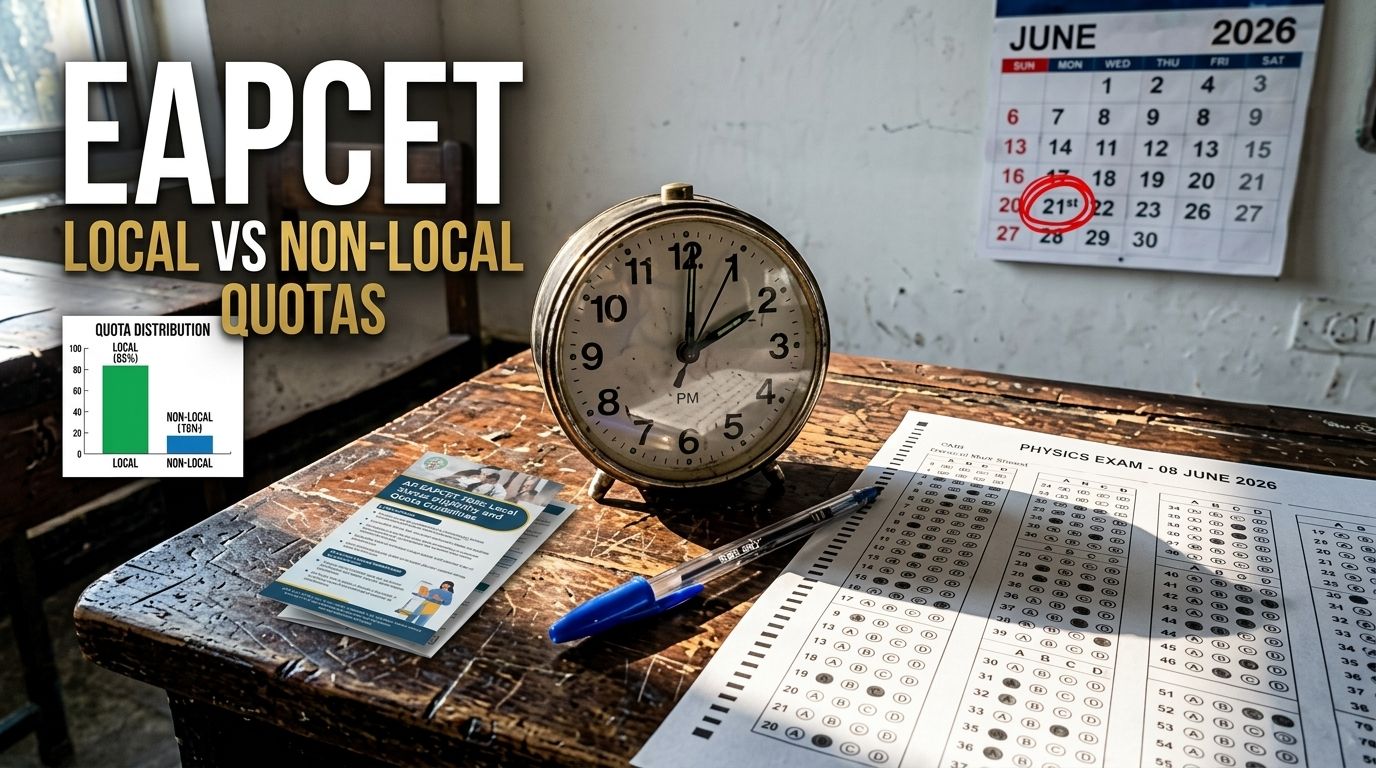
Right now, it is early June. The counseling notifications for both TS and AP EAPCET are starting to drop. You have your rank card printed out. You are probably feeling pretty good about a 12,000 or 15,000 rank. You look up last year's cutoff for JNTU Hyderabad or Andhra University, see a closing rank of 18,000 for Civil, and think you are completely safe.
Then the actual seat allotment happens. Your friend, who got a 17,000 rank, gets the seat. You, with your 12,000 rank, get rejected.
You sit there staring at the screen, entirely convinced the system is broken or someone paid a bribe. But nobody cheated. You just got hit by the geographical reality of Article 371D.
Unlike JEE Main, where marks versus percentiles behave somewhat nationally, state counseling in the Telugu-speaking states is carved up into three invisible, fiercely protected borders: OU, AU, and SVU. If you do not understand exactly which of these three borders you belong to, filling out your web options is basically playing roulette blindfolded.
VRSAM Analytics: The 85% Reservation Mathematics
Our educational research team at VRSAM tracked the historical changes made by the NTA over the last three exam cycles. Based on our evaluation of recent paper patterns, here is our custom blueprint for the 2026 syllabus.
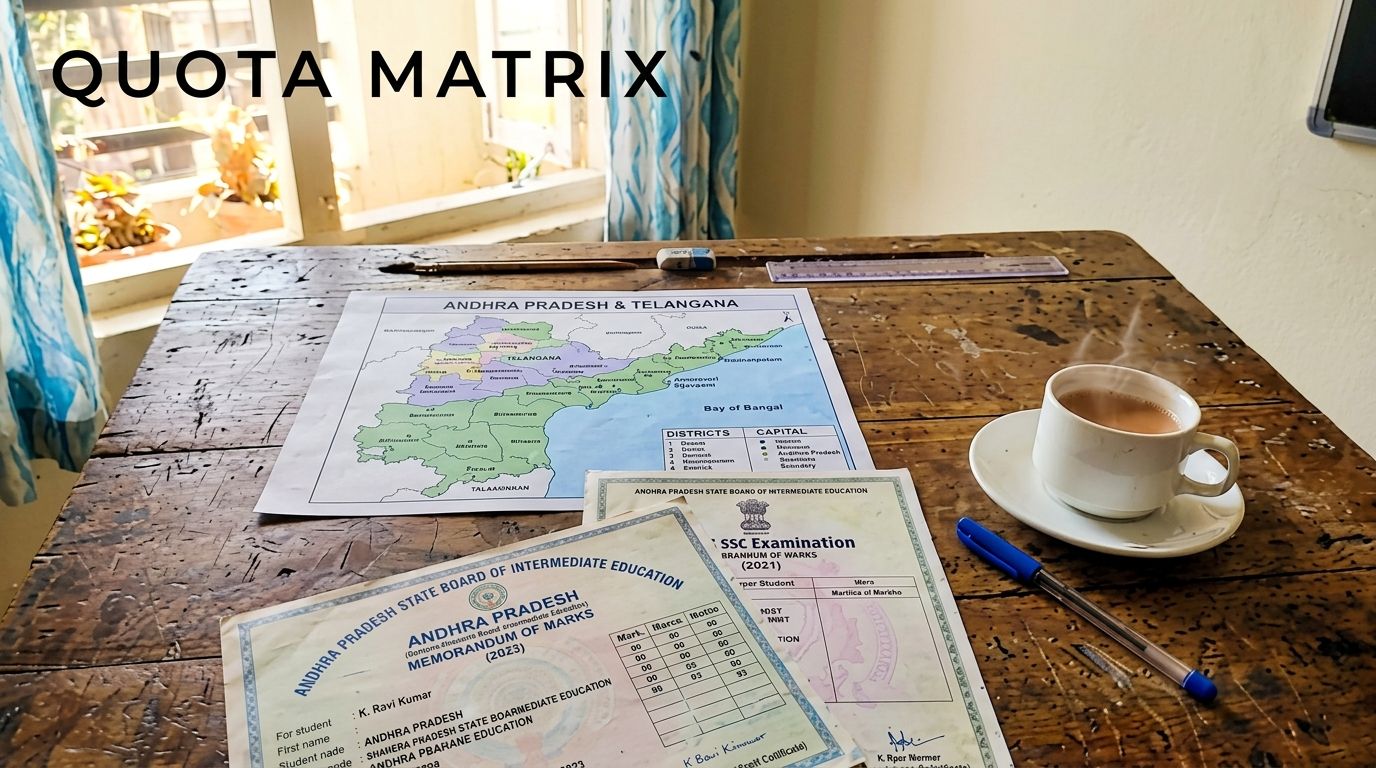
To fundamentally grasp the EAPCET counseling mechanism, one must first dismantle the misconception that the state rank is the final arbiter of a seat. The algorithm heavily layers the rank beneath a rigid geographical matrix mandated by Presidential Order under Article 371D. The two states (Andhra Pradesh and Telangana) are historically and legally divided into three local university areas: the Osmania University (OU) region encompassing all districts of Telangana; the Andhra University (AU) region covering Coastal Andhra; and the Sri Venkateswara University (SVU) region mapping to Rayalaseema.
Our analytical modeling of the seat distribution algorithm reveals the absolute dominance of the 85% local reservation rule. Within any given engineering or pharmacy college located in these states, exactly 85% of the available convened seats are constitutionally locked exclusively for students designated as "Local" to that specific university region.
The determination of this "Local Status" is purely mechanical, completely ignoring where the student was born or where their parents own property. The VRSAM data tracking shows that the algorithm calculates domicile based strictly on the student's continuous academic residency. Specifically, the software audits the student's study certificates for the 7 consecutive academic years immediately preceding the qualifying examination (Intermediate/Class 12). The region where the student spent the maximum number of years within this 7-year block—usually requiring a minimum of 4 consecutive years—is permanently stamped as their Local Area. If a student studied from Class 6 to 12 entirely in Vijayawada, they are stamped as AU local. Even if they temporarily shift to Hyderabad for long-term coaching after Class 12, their local status remains rigidly locked to AU.
The most violent misunderstandings in web options arise around the remaining 15% of the seat matrix. Coaching centers frequently mislabel this as the "Non-Local Quota." Our analytics team stresses that this terminology is statistically dangerous. The algorithm treats this 15% strictly as an "Unreserved Pool." It is purely meritocratic. A local student with an elite rank can mathematically consume a seat from this 15% unreserved pool, thereby freeing up a seat in the 85% local pool for a lower-ranking local peer.
Consequently, when an AP student (AU or SVU local) attempts to secure a computer science seat at a premier Telangana institution like JNTUH or CBIT, they are not competing in an open state-wide pool. They are fighting violently for a fraction of that 15% unreserved slice against the absolute top rankers from all three regions simultaneously. This dynamic artificially inflates the cutoff required for non-locals. For instance, if the closing rank for a local OU student for CSE at a top-tier Hyderabad private college is 4,500, the mathematical cutoff for an AU or SVU student attempting to claim that exact same seat from the unreserved pool often compresses to below 1,200.
The final layer of complexity in our 2026 forecasting models involves the intersection of caste reservations and regional quotas. The system calculates vertical reservations (SC/ST/BC) and horizontal reservations (Women/EWS) entirely within the boundaries of the 85% local pool first, before processing the unreserved pool. A student failing to produce an unbroken chain of study certificates from Class 6 to 12 during document verification automatically defaults to the "Non-Local" category across all three regions, subjecting their entire rank to the brutal mathematical compression of the 15% unreserved pool.
The "Study Certificate" Trap
If you read that VRSAM analysis carefully, you should realize that your rank isn't actually your most valuable asset right now. Your old school bonafide certificates are.
I see kids panic every June. They go to the helpline center for certificate verification. The officer asks for their study certificates from Class 6 to Intermediate. The student hands over a stack of papers, but they are missing the 7th-grade certificate because they changed schools and the administration lost the file.
The officer doesn't care about your story. They look at the broken chain. Because the 7 consecutive years cannot be verified, the software immediately strips away your 85% local reservation. You are instantly thrown into the 15% unreserved bloodbath. A rank that would have guaranteed you ECE in your hometown now barely gets you Mechanical Engineering in a rural college. Go find your certificates. Dig through your closets today.
Crossing State Lines (AP to TG, TG to AP)
A lot of AP students write the Telangana EAPCET because they want the software placements in Hyderabad. A lot of Telangana students write the AP EAPCET because they want specific legacy colleges in Vizag or Tirupati.
If you are crossing the border, you are playing on hard mode. Let's say you are an AU local from Vijayawada trying to get into VNR Vignana Jyothi in Hyderabad. You are strictly fighting for that 15% unreserved seat.
This is why looking at last year's general cutoff lists online is dangerous. Those lists usually display the closing rank for the local demographic. You might see a cutoff of 8,000 and put it as your first option, not realizing that for you—as a non-local—the actual cutoff was 1,500. You waste your web options chasing ghosts. You have to specifically check the "Unreserved (UR)" closing ranks.
If you want a clearer picture of how this placement reality actually plays out between states, check our breakdown of exam and counseling strategies to see the difference between an NIT seat and a top state college.
Frequently Asked Questions
What happens if I studied equally in two different regions?
This happens when kids move in the middle of their schooling. If your 7 years of consecutive study are split exactly equally (for example, 3.5 years in the AU region and 3.5 years in the SVU region), the tie-breaker is where you completed your qualifying exam. The region where you wrote your Class 12 / Intermediate final exams becomes your official local area.
Is the 15% quota reserved strictly for students from other states?
No. This is the single biggest misconception that ruins web option lists. The 15% is unreserved, not non-local. It is purely merit-based. A local student from Hyderabad with a top 100 rank can easily claim a seat in this 15% pool in an OU college, leaving their 85% local seat empty for a slightly lower-ranking local student to take.
Can an AP student get full fee reimbursement in Telangana EAPCET?
Generally, no. Following the state bifurcation rules, fee reimbursement schemes (like the ones providing free tuition for specific ranks or income brackets) are funded by the respective state governments specifically for their own local residents. An AP student securing an unreserved seat in an OU region college typically has to pay the full tuition fee out of pocket. You need to factor this into your financial planning.
Stop stressing over the cutoff numbers right now. Before you even open the choice filling portal, go secure your physical paperwork. Make sure every single year of study from 6th grade to Inter 2nd year is documented on a stamped letterhead from your school. Your local status is your shield. Do not lose it over a missing piece of paper.