
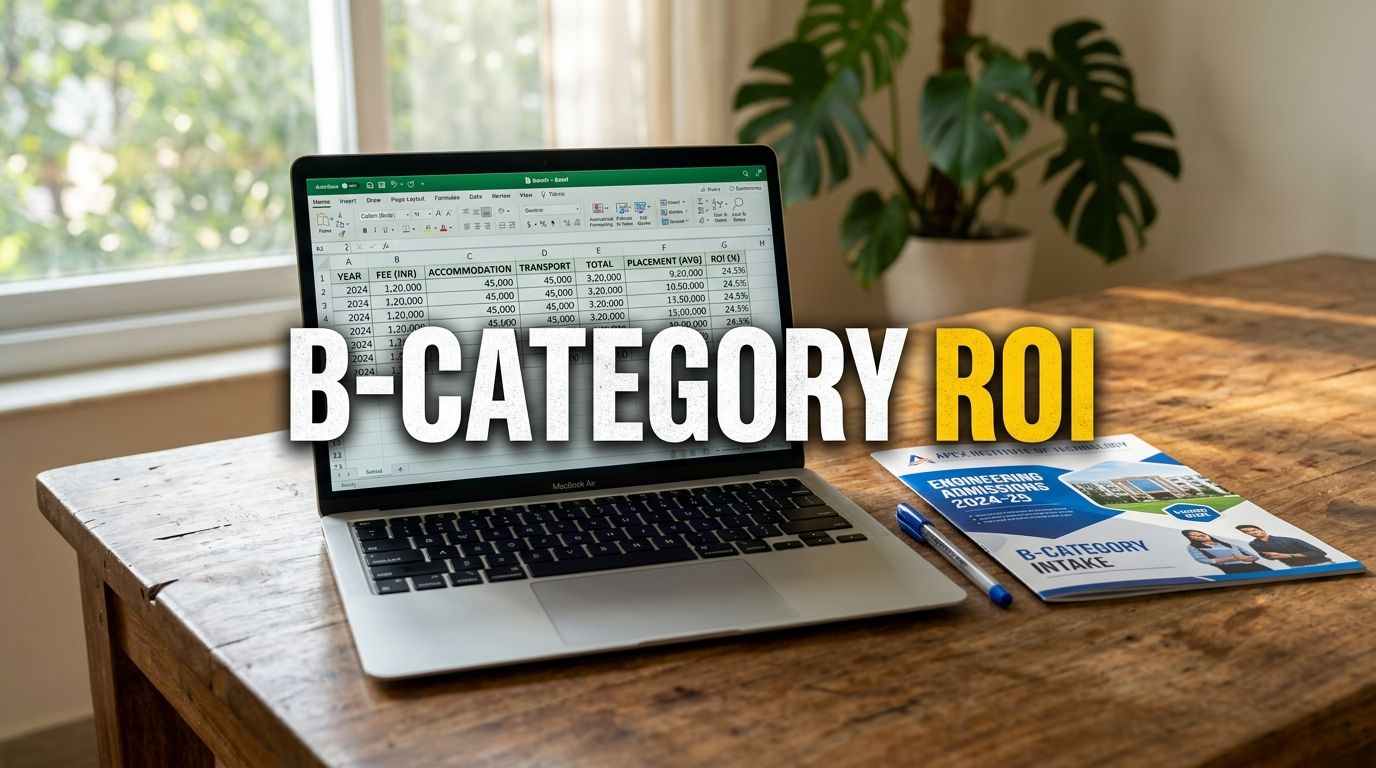
It happens exactly around mid-June every year. The EAPCET ranks are out, the JEE Main percentiles are finalized, and you are staring at a state rank of 45,000. You know immediately that you aren't getting Computer Science at any Tier-1 or Tier-2 college in Hyderabad or Vizag through the regular Convener quota.
Then the phone calls start. Agents, brokers, or even relatives begin floating the idea of a "B-Category" seat. Management quota.
You sit in your living room with the AC humming, watching your dad pull out a calculator. He starts talking about breaking fixed deposits or taking an education loan against the house. He says, "It’s okay, an engineering degree from a top college is an investment. You will get a good job and pay it back."
That statement used to be true in 2015. In 2026, it is a massive, highly dangerous gamble. The math of the Indian IT sector has fundamentally broken away from the cost of private education. We need to strip away the emotional blackmail of "doing whatever it takes for your child" and look exclusively at the cold financial mechanics of buying an engineering seat today.
VRSAM Analytics: The B-Category Financial Autopsy
Our educational research team at VRSAM tracked the historical changes made by the NTA over the last three exam cycles. Based on our evaluation of recent paper patterns, here is our custom blueprint for the 2026 syllabus.
To evaluate the financial viability of a Management Quota seat, we must first establish the true Capital Expenditure (CapEx). In both Andhra Pradesh and Telangana, 30% of seats in private engineering colleges are legally reserved for the Management Quota, commonly referred to as B-Category. While state regulatory bodies technically cap these fees, the actual out-of-pocket reality for top Tier-1 institutions (such as CBIT, VNR Vignana Jyothi, Narayanamma, or GVP) behaves differently.
For the 2026 academic cycle, the official tuition fee for a B-Category CSE or AI/ML seat in a premier Hyderabad or Vizag college oscillates between ₹3.5 Lakhs to ₹5 Lakhs per annum. However, our analytics team factors in the mandatory peripheral costs: premium hostel and mess fees (averaging ₹1.2 Lakhs annually), transportation, high-end laptops required for CSE curriculums, and unavoidable placement training charges. The total 4-year expenditure consistently balloons to a minimum of ₹18 Lakhs to ₹24 Lakhs.
The financial danger triggers when a middle-class family relies on credit to bridge this gap. Assuming a family takes a ₹16 Lakh educational loan to fund a B-Category seat, the current macroeconomic reality becomes restrictive. Banks do not issue unsecured loans above ₹7.5 Lakhs. Therefore, this loan requires tangible collateral, legally mortgaging the family’s primary residence or locking equivalent fixed deposits. With prevailing floating interest rates hovering at 10.5% to 11%, simple interest accumulates brutally during the 4-year study period plus the standard 1-year moratorium. By the time the student enters repayment in 2031, the total repayable principal plus accrued interest typically scales to approximately ₹22.5 Lakhs.
To service a ₹22.5 Lakh loan over a standard 7-year repayment window at 10.5%, the Equated Monthly Installment (EMI) mechanically demands roughly ₹38,000 per month.
This EMI mathematically collides with the reality of the 2026 entry-level job market. The core justification for buying a Tier-1 college seat is the campus placement cell. However, placement data is highly skewed. While the top 15% of the graduating batch might secure product-based roles offering ₹10 LPA to ₹14 LPA, the vast majority—the median 65% of the batch—are absorbed by mass recruiters or mid-tier service companies (like TCS Ninja, Cognizant, or local GCCs).
The median entry-level package for a CSE graduate in 2026 remains stagnant at approximately ₹4.5 LPA to ₹5.5 LPA. A gross salary of ₹5 LPA yields a monthly in-hand take-home pay of roughly ₹38,000 after standard PF and professional tax deductions.
The deficit is absolute. The graduate’s entire monthly salary mathematically equals the bank's EMI requirement. There is literally zero capital left for rent in a metropolitan city, food, transport, or savings. The student is technically employed but financially insolvent. Consequently, the debt burden immediately ricochets back to the parents, who must service the EMI using their retirement funds. Our 5-year post-graduation projection confirms that buying a B-Category seat using high-interest debt for a median-performing student results in a deeply negative financial ROI, effectively trapping the family in a cycle of debt until the graduate's mid-30s.
The Middle-Class Trap
Read that analytics block again. Your entire entry-level salary is just going to go to the bank.
I constantly talk to parents who think that going to a good college guarantees a 15 Lakh package. They see the massive billboards on the highway claiming "Highest Package 45 LPA" and they assume that is the standard. It is a marketing trick. That 45 LPA offer was probably an off-campus placement secured by one incredibly gifted student who spent four years grinding LeetCode and building open-source projects. They didn't get that job because of the college; they got it despite the college.
If your family has huge generational wealth, and your dad can write a 20 Lakh cheque without blinking, then fine. Buy the B-Category seat. The exposure at a Tier-1 college is genuinely better. The peer group is smarter. The hackathons are better funded.
But if your family is middle-class, and you have to take a loan to do this, you are stepping into a massive trap. You will graduate at 22 years old carrying a mountain of stress. While your debt-free friends are taking risks, joining early-stage startups, or preparing for higher studies, you will be forced to take whatever boring, soul-crushing IT support job you can find just to keep the bank from taking your parents' house.
Tier-1 Management Seat vs Tier-3 Free Seat
This is the ultimate dilemma. Do you take a free (fee-reimbursed) seat in a completely unknown, remote engineering college? Or do you take the loan and buy the Tier-1 seat?
In 2026, the tech industry has flattened. Ten years ago, if you went to a bad college, you were invisible to recruiters. Today, recruiters do not physically visit campuses as much. They use automated ATS software. They run nationwide coding contests like TCS NQT, HackWithInfy, and Amazon AWS challenges.
If you take the Tier-3 free seat, you will have to work twice as hard to build your skills. Your professors will likely be terrible. But you will have peace of mind. You can buy a 500-rupee Udemy course on Full Stack Web Development, build three massive projects, upload them to GitHub, and apply off-campus. When you finally land a 6 LPA job, every single rupee belongs to you. You are completely free.
Frequently Asked Questions
Are B-Category students treated differently by software recruiters during placements?
No. Once you are admitted, your admission category becomes entirely invisible to visiting companies. The HR teams sitting in the placement cell only care about your current CGPA, your coding portfolio, and your performance in their technical interview rounds. They literally do not ask, nor do they care, if you paid for a management seat or got in via merit.
Do banks easily give education loans for management quota seats?
It is heavily restricted. Banks usually provide unsecured loans up to ₹7.5 Lakhs for students who secure seats through government merit counseling. For a B-Category seat costing ₹15 Lakhs or more, the bank will demand tangible collateral. Your parents will have to legally mortgage physical property (like a house) or lock up fixed deposits to secure the funds.
Is paying for IT or ECE worth it if I do not get a CSE B-Category seat?
Paying premium management fees for anything other than CSE, IT, or highly specialized branches like AI/ML is incredibly risky in 2026. Taking out a massive loan for ECE or Mechanical, hoping to randomly learn coding on the side and pivot into software later, drastically lowers your mathematical chance of securing a positive ROI.
Sit down with your parents today. Open an EMI calculator on your phone. Type in 20 Lakhs, 10.5% interest, and a 7-year repayment schedule. Show them the monthly payment. Have the uncomfortable argument now, so you don't spend the next ten years regretting it.