
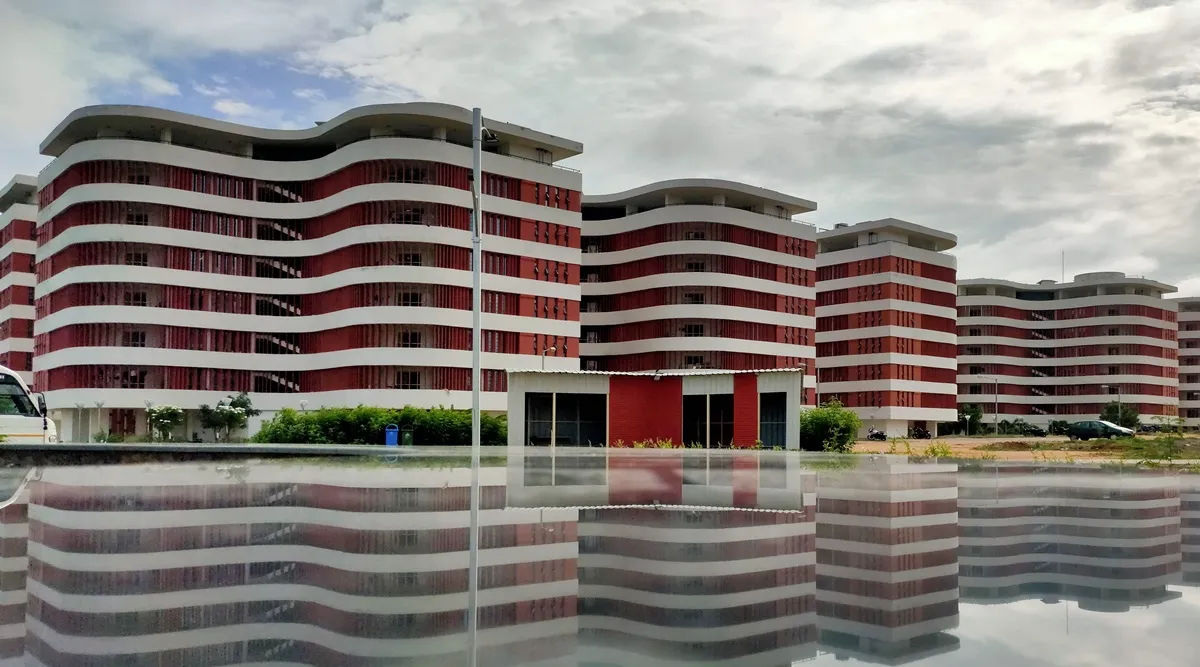
For decades, the Indian engineering landscape was dominated by an unspoken caste system. There were the "Top 5" legacy IITs, then Roorkee and Guwahati, and then everything else.
Then IIT Hyderabad (IITH) showed up.
Established in 2008, it was supposed to just be another new IIT. But due to a massive collaboration with Japan (JICA funding) and its aggressive, forward-thinking administration, it completely shattered the hierarchy. Today, when students check their JEE Advanced rank matrices, a massive chunk of top rankers willingly drop lower branches at IIT Kanpur or Kharagpur to take Computer Science or Artificial Intelligence at IIT Hyderabad.
But IITH is not a traditional college. The moment you step onto the massive Kandi campus, you realize you are in an experiment. The grading system is different, the semester structure is fractured, and the pressure is relentless. If you are locking this seat in your JoSAA portal, you need to know exactly what kind of academic machine you are walking into.
IIT Hyderabad: 2026 At a Glance
To understand why IITH is beating older institutes, look at its course catalog. It doesn't rely purely on 50-year-old traditional engineering branches. It was the first in India to introduce a B.Tech in AI.
| Category | Current Details (2026) |
|---|---|
| Location | Kandi, Sangareddy (~50 mins from Hyderabad's IT Hub) |
| Campus Size | 576 Acres (Incredibly modern, geometric Japanese architecture) |
| B.Tech Tuition Fees (4 Yrs) | ~ ₹8.5 Lakhs (General Category, excluding hostel/mess) |
| Total Estimated Cost | ~ ₹12.5 Lakhs (Single occupancy rooms with radiant cooling add value) |
| Flagship Courses | Artificial Intelligence (AI), Computer Science, MnC |
| Unconventional Branches | Engineering Science, Computational Engineering, IC Design |
| Overall Median Package | ~ ₹22.5 LPA (Consistently punching above legacy IITs) |
Note: Similar to all central institutes, 100% tuition fee waivers exist for SC/ST students, and generous subsidies apply for economically weaker sections.
VRSAM Analytics: The "Gachibowli Premium"
If you want to know why IIT Hyderabad’s placement statistics frequently embarrass older colleges, you have to look at the map. The VRSAM Internal Analytics Team modeled the hiring patterns for the 2026 graduating batch, and the driving force is what we call the "Gachibowli Proximity Premium."
Geographic isolation is a massive hurdle for places like IIT Guwahati or Kanpur. IIT Hyderabad sits right on the edge of the Outer Ring Road, basically a straight drive down to HITEC City and Gachibowli—one of Asia's most dense IT and startup corridors. Global Capability Centers (GCCs), High-Frequency Trading (HFT) firms, and multinational tech giants (Microsoft, Amazon, Apple) don't have to book flights to hire here. They send an Uber.
The internal data for the B.Tech in Artificial Intelligence and Computer Science is staggering. The median package for these circuit branches comfortably hits ₹34 to ₹36 LPA in 2026. Because IITH students are so physically close to the industry, their off-campus networking is elite. It is incredibly common for third-year students to undertake physical, part-time internships at startups in the city while managing their coursework, building real-world software portfolios that isolated students simply cannot match.
However, this tech obsession cannibalizes the core branches. If you take Civil or Chemical Engineering at IITH, you will notice a distinct lack of core manufacturing recruiters compared to an older institute like IIT Roorkee. The local ecosystem is purely digital. Consequently, our tracking indicates that nearly 60% of core branch students at IITH aggressively self-teach data structures, machine learning, or quantitative finance. They leverage the flexible academic system to take minors in AI or computing, effectively converting themselves into software engineers by their final year to tap into the local tech goldmine.
The "Fractal Academics" Burnout Trap
This is the most critical thing you need to know about IIT Hyderabad. They do not follow the standard Indian semester system. They operate on "Fractal Academics."
In a normal college, you take five subjects. Each subject is 3 or 4 credits, runs for 16 weeks, and you have one mid-term and one final exam. You can basically sleep for two months, cram for five days, and pass.
At IITH, courses are fractured. You might take a highly specialized subject that is only 1 credit. It starts on a Monday and finishes three weeks later. Then you immediately take the final exam for it, and a new 1-credit course begins.
On paper, this is brilliant. It allows you to study hyper-modern, niche topics (like Deep Learning in Healthcare) without committing a whole semester to it. But in reality, it is a psychological meat grinder. Because courses start and end constantly, you are literally giving quizzes, mid-terms, or final exams every single week of the year. There is no downtime. The continuous evaluation is exhausting. If you have poor time management, Fractal Academics will destroy your CGPA by December of your first year.
The Japanese Connection and Infrastructure
Let's talk about the physical campus, because it is arguably the best in the country. Because IITH was heavily funded and designed in collaboration with Japan (JICA), it does not look like a standard Indian government building.
The architecture is striking, featuring massive exposed concrete and geometric designs. But the real luxury is in the hostels. Unlike older IITs where you are crammed into a tiny, decaying room with two other people and a noisy ceiling fan, IITH offers single-occupancy rooms from the very first year.
More importantly, the hostel beds feature a technology called "Radiant Cooling." Cold water runs through pipes embedded in the concrete, keeping the room temperature naturally low without traditional air conditioning. Surviving the brutal Hyderabad summer heat while having your own private, quiet space to study or code is an unbelievable luxury that students at IIT Bombay or Delhi would kill for.
The Rise of AI and Double Majors
IIT Hyderabad is incredibly flexible with its curriculum. If you miss out on the highly coveted B.Tech in AI during JoSAA counseling, the door is not fully closed.
IITH allows you to pursue a Minor in Artificial Intelligence alongside your core degree (like Mechanical or Chemical). You take extra fractional credits taught by the elite AI faculty. When placement season arrives, having a "Minor in AI" from IIT Hyderabad on your resume acts as an absolute sledgehammer to get past automated resume screeners. It is one of the most effective ways to bypass the core engineering placement drought, but it requires you to basically survive a 130% academic load.
Frequently Asked Questions
Is IIT Hyderabad actually better than older IITs like Guwahati or Roorkee?
For core tech branches (CSE, AI, MnC), yes, it arguably is. The physical proximity to Hyderabad’s massive IT and startup corridor gives it an immense placement and off-campus networking advantage over geographically isolated older IITs. However, for legacy core branches like Civil or Mechanical, the older IITs still hold a stronger, wider alumni network in traditional manufacturing sectors.
What exactly is Fractal Academics at IIT Hyderabad?
Instead of massive 4-credit courses that last a whole 16-week semester with just a mid-term and final exam, IITH breaks subjects into 1-credit or 1.5-credit fractions. This means a niche course might only last a few weeks. It allows extreme specialization, but it also means you are literally writing quizzes, project submissions, and final exams every single week of the year. There is zero downtime.
Is the B.Tech in Artificial Intelligence worth choosing over standard CSE?
Absolutely. IIT Hyderabad was the first premier institute in India to offer a dedicated undergraduate degree in AI. It is not just a rebranded IT degree. It is deeply integrated with hardcore mathematics, machine learning algorithms, and cognitive science. If you want to work in pure AI research or quantitative finance, it is one of the most elite degrees in the country.
IIT Hyderabad is the future of Indian engineering education. The infrastructure is world-class, and the placements are elite. But the Fractal system will test your discipline every single week. If you are ready for a relentless, fast-paced environment and want to be in the center of the tech boom, lock the seat. If you want a relaxed, traditional college life, look elsewhere.